


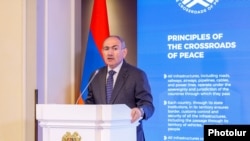
Speaking earlier at the opening of a two-day international conference in Yerevan, which was also attended by Azerbaijani experts, Pashinian said that while the conflict between Armenia and Azerbaijan had been politically resolved, it remained unresolved on a social and psychological level.
In his remarks on Monday, the Azerbaijani leader, in particular, referred to Lake Sevan, Armenia’s largest body of fresh water, as Goycha, stressing that this Azerbaijan name appeared on early 20th-century Russian imperial maps.
He also suggested that the return of ethnic Azerbaijanis who left Armenia amid ethnic tensions in the 1990s should not frighten the Armenian people or state because “Azerbaijanis have never pursued separatism.” Aliyev added that Azerbaijanis would be returning to Armenia “in automobiles rather than on tanks.”
Pashinian hesitated to answer the journalist’s question straightforwardly, saying that before doing so he would need to clarify what exactly the Azerbaijani president had said.
“If we are to look at Tsarist-era maps, well, let’s take a look… I already mentioned Kirovabad and Kirovakan, but did not mention Yelizavetpol and Alexandropol. In other words, we must make a choice,” Pashinian said, referring to the historical names of cities in modern-day Azerbaijan and Armenia used during Soviet and Tsarist times.
The Armenian leader added that he had largely answered the question in his speech at the forum where he spoke about the state of relations between the two South Caucasus nations.
“A 30-year social and psychological reality cannot be stopped simply by turning off a switch or applying the brakes,” he said. “This logic is expressed from time to time both in Azerbaijan and in Armenia – in the media, in public and expert circles, and even at the leadership level of our countries. We need to find the right formulas for dealing with this phenomenon.”
Pashinian reiterated his view that, politically, the conflict with Azerbaijan is over. “This peace is a peace created by our own hands — by Armenia and Azerbaijan — and this is the first shared value the two countries have created together,” he said.
At the same time, the Armenian prime minister emphasized the need to treat history carefully. “If the Greeks start recalling Alexander the Great, or Italians the Roman empire, where would we all end up? We have read that history, and in my view, we have already created a new one. Even two years is already history. We must be able to distinguish the past from the future,” Pashinian said.
He also described Baku’s agenda of pursuing the return of Azerbaijanis to Armenia with just one word: “dangerous.”
During the same event, Pashinian also revealed that he had formally invited Turkish President Recep Tayyip Erdogan to attend the European Political Community summit, which is scheduled to take place in Yerevan next spring. He said he extended the invitation to Erdogan during his working visit to Turkey earlier this year and expressed hope that the Turkish leader would accept it.
Foreign Minister Ararat Mirzoyan recently said that invitations to attend the event in Yerevan had been sent to both Erdogan and Aliyev.
Erdogan’s administration said last week that a decision on whether the Turkish leader will visit Yerevan will be made closer to the date, while Hikmet Hajiyev, an aide to the Azerbaijani president, said he did not think that Azerbaijan’s participation in the Yerevan summit at the highest level was possible “under the current circumstances.”